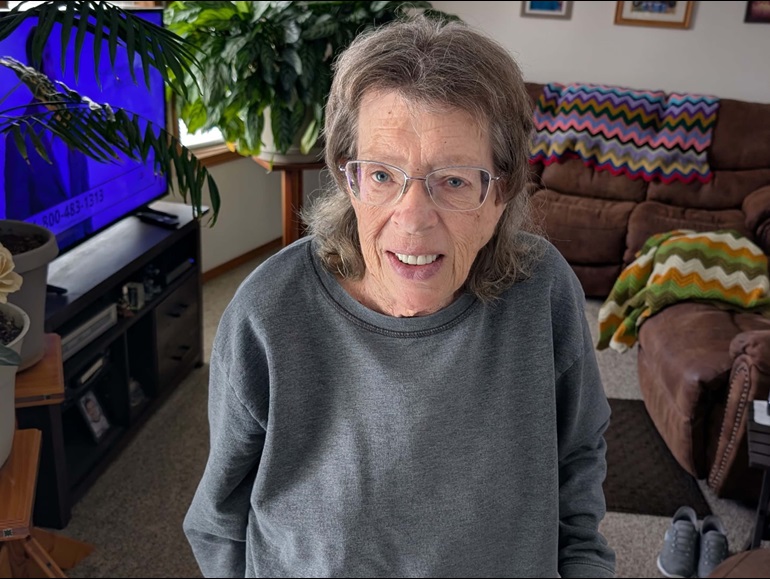
Wisconsin woman fights to recover after life-altering stroke

Debra Malchow’s life unraveled without warning. The 67-year-old Wisconsin woman, who loved Sunday church and chatting with neighbors, was fine when her husband, Bob, left the house one morning for an appointment. But when he returned, he found her slumped in a chair and speaking in garbled words. Bob quickly called for help.
An ambulance rushed Debra to a local hospital, where scans revealed a large cerebellar hemorrhage – bleeding in the brain – with fluid buildup. Debra’s condition deteriorated quickly. She was intubated and flown to Aurora St. Luke’s Medical Center in Milwaukee, where surgeons removed part of her skull to relieve brain pressure. In addition to placing her on a ventilator, doctors eventually performed a tracheostomy (trach), creating a surgical opening in her neck and placing a tube into it so air could get directly into her lungs. After four weeks in intensive care, her condition had stabilized and she was off the ventilator, but the trach remained. She could not speak, eat or walk on her own.
Unable to find a facility near their home in Omro that would take a patient with a trach, her family made the decision to transfer her to Select Specialty Hospital – Milwaukee St. Francis, a critical illness recovery hospital. There, a physician-led, multidisciplinary team put together a personalized plan to help Debra get back to the life she knew before her illness – going to dinner with Bob, playing games and enjoying her grandchildren.
New chapter
Under the guidance of a pulmonologist, the respiratory therapy team slowly reduced Debra’s dependency on oxygen through her trach. Only four days after admission, she reached her first big milestone. A special valve was attached to her trach that pushed air through her vocal cords. For the first time in five weeks, she found her voice again and could talk with her family and care team.
“When she said ‘Hello,’ both my daughter Stacy and I cried,” said Bob, remembering that moment.
Debra’s physical and occupational therapy teams also played an important role in helping her rebuild her strength, range of motion and balance. When she first arrived, it took two therapists to help her balance on the edge of the bed. Through daily core exercises, weight shifts and leg strengthening exercises, she got back on her feet. Five days after she arrived, she stood with support for the first time.
In occupational therapy, she practiced grooming exercises such as brushing her hair and getting dressed.
Debra told her care team how their laughter and encouragement lifted her spirits and kept her motivated, even on the toughest days.
“Their consistent support and kindness made me feel safe, motivated and truly cared for,” she said, as tears rolled down her cheeks.
Achieving milestones
At the same time, Debra’s speech-language pathologist guided her through exercises to strengthen her throat muscles so she could eat again. After four weeks, a special study confirmed she could safely swallow. She started with pureed food and honey-thickened liquids, then transitioned to a regular diet nine days later.
“It was definitely a process,” said Bob, explaining how he and Stacy encouraged Debra to eat the pureed food despite her initial hesitation. “Once she moved on to soft foods and (supplemental shakes), her appetite improved.”
Seven weeks into her stay, Debra was able to breathe on her own, paving the way for her trach to be removed a few days before her discharge.
Reflecting on her progress, she expressed deep gratitude for the care she received.
“You’ve helped me tremendously. I’m able to eat and talk again,” she said. “There were hard parts, but I did it. I wanted it for myself.”
Debra also found strength in her family, who made the nearly 200-mile roundtrip to see her every other day.
“They’ve been my biggest support,” she said.
Back home
Nearly two months after arriving at Select Specialty Hospital, Debra transferred to a skilled nursing facility, where she spent seven weeks continuing her recovery before completing outpatient therapy at home.
“Now it’s just Deb and me, and we do it together,” said Bob, proud of the progress they continue to make.
In addition to improving her speech, Debra’s walking with a cane, making breakfast, helping with the dishes, and catching up with the neighbors. She’s also eating the foods she loves and gaining back some of the weight she lost.
“Now we can go to Hardees!” she said with a laugh. “I feel wonderful.”
They also have plans to return to Select Specialty Hospital in early spring to personally thank the staff for what they describe as a “five-star” experience.
“We want to say thank you to the people that we really got along with and who really took care of Deb,” Bob said. “We’re very, very happy.”