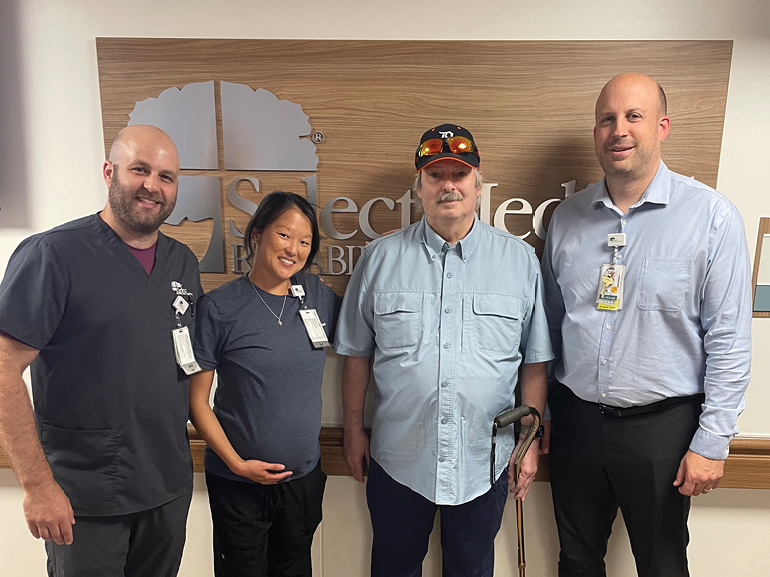
Steve's Story

Steve Sopcak remembers the intense abdominal pain. He remembers calling a friend to take him to University of Wisconsin Medical Center and unlocking his phone in the emergency room so someone could notify his sister, Mary. He remembers lying on a gurney, knowing something was very wrong.
Steve’s next clear memory came four weeks later, when he was transferring to Select Specialty Hospital – Madison.
Steve knew nothing of the ruptured abdominal aortic aneurysm and the infections, fevers, clots and other complications that nearly took his life. He did not know that for two days, doctors could not close the slit they had made from his chest to his abdomen because of internal swelling.
“They told my family it was 50/50 whether I would make it,” Steve said.
“At one point, it wasn’t even that high,” recalled his sister, Mary Schmidt.
Steve, 65, lives in a small town southwest of Madison. He had no major health concerns before the aneurysm and enjoyed a successful career in information technology. One of eight kids, Steve already lost two brothers; the rest of his siblings live in Michigan, his home state, including Mary, a neurodiagnostic technician at a hospital.
As Steve lay sedated in the trauma intensive care unit, Mary was the conduit between his care team and his loved ones.
Steve underwent four surgeries. The first was to graft the ruptured aorta. Five days later, surgeons checked his organs for damage from complications and partially closed his incision. Steve returned to the operating room a third time to close the rest of the incision and to replace his breathing tube with a tracheostomy (trach) that connected to a ventilator. Steve’s fourth surgery was to replace the trach when it leaked air.
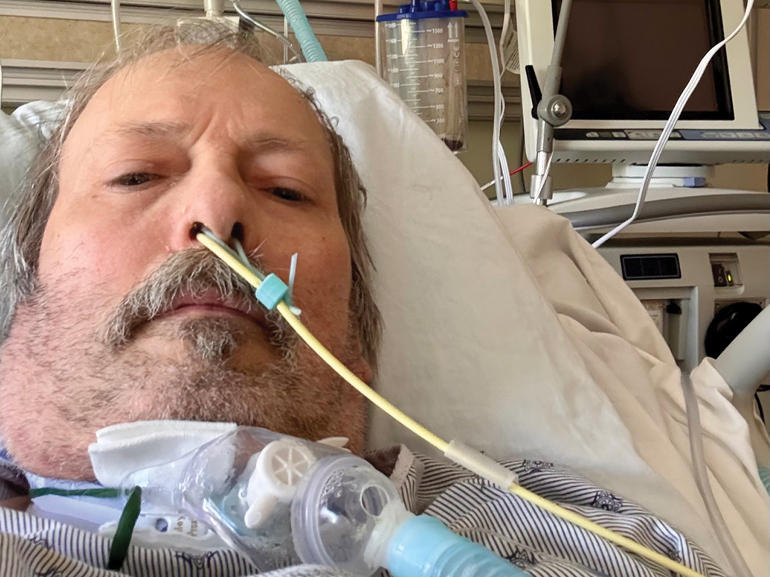
Despite numerous life-threatening complications, Steve survived. His loved ones have told him that at different times, he was awake in the intensive care unit but he has only vague memories of “seeing all these tubes and all these people … and being extremely overwhelmed and anxious.”
Steve stabilized and began to wake up. He could not breathe, eat, talk, walk or think clearly. He was still on a ventilator, a feeding tube and had a central line for his many IV medications.
Working hard to recover
He transitioned to Select Specialty Hospital - Madison, a critical illness recovery hospital, for extended healing. A physician-led, multidisciplinary team collaborated on a plan that included respiratory, speech, physical and occupational therapy to get Steve back to the activities he enjoyed – such as hiking and woodworking -- before his aneurysm
The day after admission, Steve began breathing trials in which his respiratory therapist reduced his ventilator settings so that he breathed on his own for brief but increasing amounts of time each day. Steve remembers being anxious at the prospect of breathing without the ventilator, and his therapist reassuring him that it would be okay and he would remain by Steve’s side until Steve was comfortable.
Mary traveled to Madison a few days after Steve’s admission and participated in a meeting with his care team, including his case manager.
“That was amazing. I felt like they had a very clear plan,” Mary said.
She recalls Steve asking for a timeline for his recovery and the team explaining why they could not do that. Every patient is different. Every journey is different. The goal, however, is the same: to help each person regain independence and get back home.
“I felt like they really got him on the right path,” Mary said. “He needed that clear, concise plan.”
His care team helped him sit on the edge of the bed or in a chair so that he was upright and rebuilding core strength. They moved his arms and legs, and attached a special valve to his trach that allowed him to speak again. They cleaned and bandaged his incision.
Steve advanced quickly. Within a few days, he stood with assistance. Within a week, he no longer needed the ventilator. Two days later, his trach was removed.
“My attitude was this: I’m going to do whatever they ask because they are there to help me get back to normal,” he said.
Steve passed a study that demonstrated he could swallow without aspirating and was allowed ice chips, then thickened liquids and soft foods, then a regular diet. His feeding tube and IVs came out.
Steve’s cognition advanced from answering simple yes or no questions to mouthing words and following simple instructions. He could stand for a full minute with a walker.
Transitioning to inpatient rehabilitation
At this point – only 12 days after admission – Steve was ready for inpatient rehabilitation. He rode the elevator two floors down to Select Medical Rehabilitation - Madison, where over the next eight days, he continued his rapid progress.
In the gym, he worked to improve his strength, stamina and balance, completing repetitions of exercises between the parallel bars or riding the recumbent bike. In his room, he practiced activities of daily living such as showering, dressing, brushing his teeth and using a toilet. He’s grateful for the way his care team made recovery fun, such as the day he played corn hole with another patient or when his care team moved the furniture in his room so he could host a card game with three friends. “That’s how vested they were in my care and wellbeing,” Steve said.
Everything they asked him to do, “I did and I did it my very best,” he said. “I had faith in the people and the process.”
He remembers two key milestones that prompted proud text messages to his family and friends: when he walked from his room, down the hall and back again, and when he climbed a flight of stairs for the first time, amazing even his therapist.
Select Medical Rehabilitation has a room that mimics an apartment. There, in preparation to go home, Steve had to stand for 30 minutes, put dishes in a cabinet, cook, do laundry and demonstrate that he could manage his medications.
Fifty days after his aneurysm, Steve made it home. He used a walker for a few days, then a cane, but now needs neither. He is driving and living his life again – with deeper gratitude. He looks forward to visiting his family in Michigan in the near future.
“Select had the best cheerleaders for him,” Mary said. “They all were very good to him and it just went very well. I think that’s what made him have such a successful recovery.”
Steve added, “The diversity of the staff and their willingness to put patients’ needs first makes the Select staff exceptional, and I was lucky to have them take care of me.”
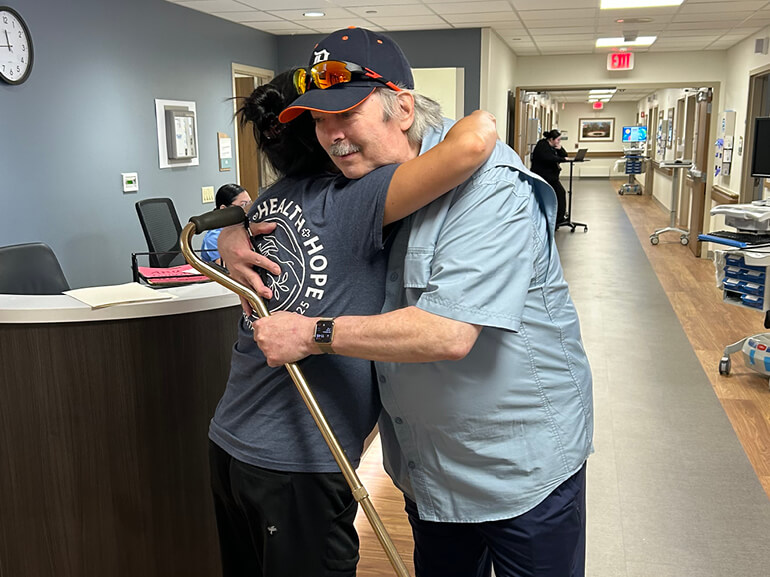
Within three weeks after discharge, Steve made surprise visits to the University of Wisconsin Medical Center, Select Specialty Hospital and Select Medical Rehabilitation, delivering snacks and appreciation to the teams he says saved his life.
“We all need to respect and thank our health care providers,” he said. “Without them, I wouldn’t be here.”