Three months after a stroke nearly took his life, Wisconsin man makes it home

By the time Jeff Koehler arrived at Select Specialty Hospital – Madison, his wife, Peg, was hoping for the best while bracing for the worst.
Several doctors had already told Peg that Jeff was unlikely to recover. The first night at Select Specialty Hospital, as he lay unconscious amid a maze of monitors and machines, there were conversations about whether he would survive. Peg called close family and friends, saying if they wanted to see Jeff, they should come soon.
Jeff, 70, a retired auto parts store owner, had suffered a stroke after a blood clot formed on his mechanical heart valve and traveled to his brain. What followed was a cascade of complications: seizures, brain bleeds, emergency neurosurgery and repeated setbacks that left him ventilator dependent, unable to swallow, barely responsive and fighting pneumonia.
Today, Jeff — once a par golfer — is back home in Mineral Point, Wisconsin, working toward his next round.
A Life Interrupted
Before his collapse, Jeff and Peg were enjoying retirement at their home located on two acres across from a golf course where they had been members for decades.
On a fall morning, Jeff stopped at a gas station while driving north for a hunting trip. He filled his truck, pulled into a side lane and stepped outside.
“That’s the last thing I remember,” Jeff said.
He collapsed after suffering a stroke. EMTs rushed him to a community hospital before transferring him to SSM Health St. Mary’s Hospital in Madison. At first, his condition appeared to improve. Jeff was awake and even walking the hallways.
Then seizures followed. Emergency surgery was required to stop bleeding in his brain.
Jeff’s condition declined rapidly. Unable to breathe on his own, Jeff was connected to a ventilator. Weeks later, with no significant improvement, doctors replaced his breathing tube with a tracheostomy — a tube into his windpipe — and inserted a feeding tube in his stomach for nutrition.
Jeff spent 45 days at St. Mary’s.
“He slept most of the time,” Peg said. “He wasn’t really talking.”
A Fragile Arrival
Jeff transitioned to Select Specialty Hospital – Madison, a critical illness recovery hospital. He was minimally responsive, battling pneumonia in both lungs and dependent on a ventilator.
Peg was not willing to consider recommendations for end-of-life care for her husband of 30 years without first giving him a chance at recovery through rehabilitation.
At Select Specialty Hospital, Peg said the physician-led, multidisciplinary team and staff treated Jeff “like he was their only patient. The CEO and caseworkers also kept a close eye on Jeff.”
Nurses and CNAs managed his complex medical needs, closely monitoring blood work as he balanced antibiotics and blood thinners. They provided continual oral care to keep bacteria out of his mouth and hence, his fragile lungs. They repositioned him frequently to prevent pressure injuries. The staff and receptionists also looked out for Peg.
Early therapy focused not on strength, but wakefulness. Speech, physical, respiratory and occupational therapists worked to increase Jeff’s alertness through structured stimulation — asking him to open his eyes, follow simple commands and respond to familiar voices. At first, his responses were inconsistent.
Then Peg noticed Jeff staying awake longer.
“That’s when I started to look to our future,” she said.
Breathing First, Then Speaking
Respiratory therapists gradually tested Jeff’s ability to breathe on his own, starting with short trials off the ventilator and increasing the time off as his lungs strengthened. As he tolerated longer periods without support, Jeff no longer required the ventilator.
Jeff was eventually introduced to a speaking valve that attached to his tracheostomy, allowing Jeff to use his voice again.
“Hearing him talk was huge,” Peg said.
With continued progress, Jeff was eventually able to have his tracheostomy removed.
Swallowing, however, remained unsafe. Jeff continued receiving nutrition through his feeding tube while speech therapists focused on exercises to strengthen his throat muscles. As his alertness and coordination improved, he began taking small amounts of food by mouth. His diet advanced gradually to thickened liquids and soft foods.
Learning to Move Again
Physical and occupational therapy began with helping Jeff sit upright, improve his balance and tolerate activity. Early attempts at standing required a mechanical device that supported his weight while therapists assisted. Other days, Jeff exercised at the edge of the bed or spent hours in a cardiac chair designed to rebuild core strength.
“He would be exhausted,” Peg said. “But the therapists never rushed him.”
Jeff remembers almost none of that time. Peg remembers all of it; she was at his side every day.
After one month at Select Specialty Hospital, Jeff reached a major milestone when he transferred to Select Medical Rehabilitation – Madison, an inpatient rehabilitation unit located just an elevator ride away.
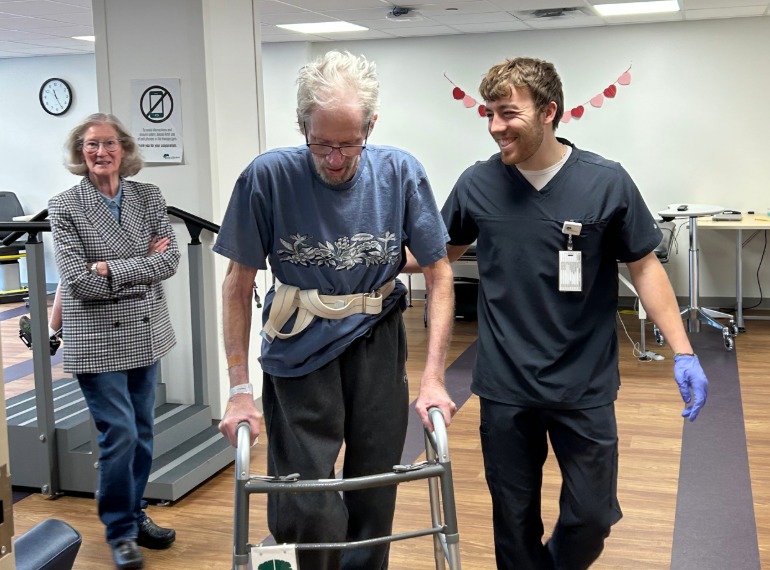
Therapy intensified to three hours each day. Physical therapy focused on strength, stamina and balance — from standing longer and shifting his weight to pedaling a stationary bike and eventually walking with a walker. Jeff progressed from parallel bars to a walker and, by discharge, needed only a cane.
“In the beginning, he was in his wheelchair a lot,” Peg said. “Then Jeff advanced to a walker, and by the end, he only needed a cane.”
Occupational therapy centered on everyday tasks such as dressing, showering and grooming, while also helping Jeff establish consistent sleep routines so he would be alert for therapy. Speech therapy targeted memory, attention, communication and vocal strength. Some days, Peg watched Jeff match words to picture cards. Other days, he read aloud to strengthen both memory and voice.
Therapists adjusted his treatment daily – challenging him while recognizing when he needed rest.
Peg said, “The therapists stressed quality time as opposed to quantity time.”
Throughout Jeff’s recovery, Peg said the compassion he received was as important as the clinical care.
“They treated him like a brother,” she said.
Staff encouraged Jeff through long therapy days, celebrated incremental progress, joked with him and even played cards with him – one of his favorite pastimes.
“One nurse really became his buddy,” Peg said. “She’d tell him he needed to turn the TV off and go to bed or she was going to call me.”
Home Sweet Home
After 24 days in rehabilitation – and 98 days total in three hospitals -- Jeff discharged home. He arrived at Select Specialty Hospital on a gurney and left walking with a cane. He continues his recovery through outpatient rehabilitation.
It wasn’t until Jeff was home that Peg explained to him the full extent of his illness.
“I had no idea that I was that sick,” Jeff said. “I always assumed I would recover because I don’t remember the worst days. When Peg told me what I went through, I was amazed.”
Now, the couple is settling back into the ordinary moments that once defined their life: watching Gunsmoke, playing cards, making dinner, taking rides and talking about the future.
Someday soon, Jeff says, “Golfing.”