Loretta's Story

Loretta Goos awoke to discover she was in a hospital, tethered to machines by a maze of tubes protruding from her body. The last thing she remembered was crawling into bed at home. That had been a week earlier.
A family member found Loretta, a fiercely independent 68-year-old homemaker from Stillwater, Okla., passed out on her bathroom floor and called 911.
“Doctors think my oxygen level went too low,” Loretta said, explaining that she lives with chronic obstructive pulmonary disease and requires supplemental oxygen.
Loretta spent a week at Stillwater Medical Center undergoing treatment for respiratory failure before she stabilized medically. While still unconscious and greatly weakened, her family had her transferred to Select Specialty Hospital – Oklahoma City, a critical illness recovery hospital known for helping patients get back to breathing on their own again.
“When I woke up, I wanted to get the tubes out of my nose and mouth and get out of bed,” Loretta said. “I thought I could just jump in the car and go.”
She quickly learned, “I could not even stand up on my own. I couldn’t use my legs.”
Her physician-led, interdisciplinary team met with her and her family to create a personalized treatment plan to help her rebuild strength and ultimately get back home.
While Loretta was still in and out of consciousness, she began a regimen of breathing trials that included giving her time off the ventilator while her care team closely monitoring how her lungs performed. Each day, Loretta became stronger and able to breathe more on her own. Just five days after admission, the tube down her throat that connected to her ventilator was gone. Loretta needed only supplemental oxygen through her nose, as she did before her illness.
Now that she was off the ventilator, Loretta was able to speak again, although her voice initially was soft – a common and temporary problem caused by irritation from the breathing tube. Her speech-language pathologist led Loretta in tongue and swallowing exercises that strengthened her throat muscles so she could eventually eat by mouth again.
About two weeks after she arrived at Select Specialty Hospital, Loretta demonstrated in a special study that she could swallow without aspirating, making it possible to have her feeding tube removed. She began a diet of soft textured foods before progressing to a regular diet.
In Loretta’s physical and occupational therapy sessions, she worked hard to improve her strength, range of motion and balance through a series of exercises that included balancing on the edge of the bed, moving her arms and legs and transitioning from sit to stand positions.
Loretta remembers the first time she tried to stand. “My legs were like jelly,” she said.
She laughed when she recalled a conversation with a therapist who was teasing her about her beloved Oklahoma State University.
“I told him, ‘My legs might not move but my arms do,’” she told him. “I liked that I could joke around with the nurses and therapists.”
Occupational therapy focused on self-care like dressing, feeding herself and transferring from her bed to a commode, chair or walker. She recalls how her hands initially shook so badly that she couldn’t hold a spoon without spilling food – and how with time and practice, that changed.
Through it all, her children visited often, encouraging her. Loretta was also motivated by the thought of returning home and spending time with her 26 grandchildren and great-grandchildren.
“I kept telling my daughter, “I’m going to walk again. I’m not giving up. And I didn’t.”
She remembers the day – the very happy day -- she could finally sit on a toilet again.
“That sounds funny, but a bedpan is so hard to use. I never thought [using] a toilet would be exciting to me,” Loretta said.
When asked if this was a turning point in her recovery, Loretta explained that it was just one of many.
“It wasn’t just one day,” she said. “It was the different things I could do again, like sit up on my own, sit on a toilet, walk with a walker, be able to eat again and [to eat] food that wasn’t pureed … and through everything, the nurses and therapists were always beside me, saying, ‘You can do it.’”
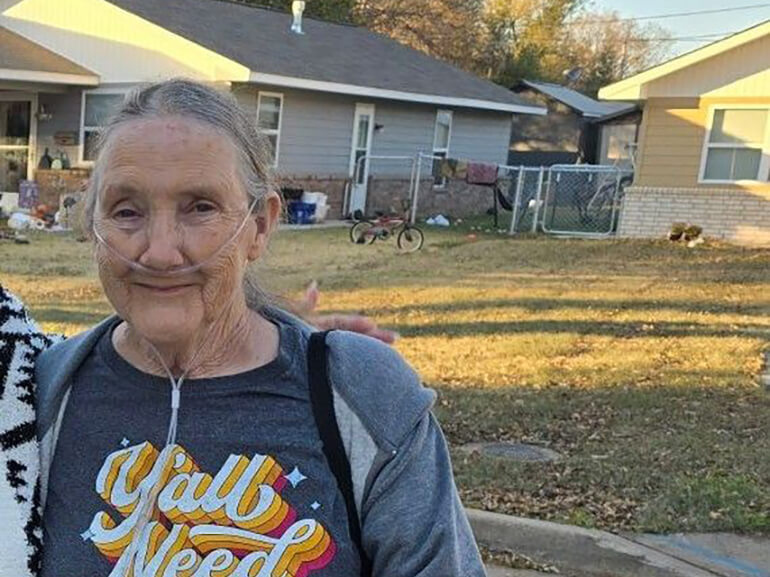
In four weeks, Loretta could talk, eat and breathe on her own. She could walk 130 feet with a rolling walker. She transferred to an inpatient rehabilitation hospital in Stillwater before moving home with her daughter, then eventually back into her own home.
“Now I’m living by myself again and getting around pretty good,” she said. “I can do everything for myself. Some things take a little bit longer, but I get it done.”
Reflecting on her journey, Loretta cautioned others not to take anything for granted, reminding them that life can change in an instant.
“Enjoy what you have – walking, eating, everything,” she said. “I will enjoy all the small things from now on, as well as the big things. They’re all precious.”