Alfred's Story

Darlene Parrillo suspected something wasn’t quite right when Fred, her husband of 56 years, reached for his cane on the way to the bathroom. Fred, an Army veteran and retired maintenance worker at the University of Cincinnati, rarely used his cane.
When Darlene heard it fall, she knew Fred was in trouble. She found him lying on the floor, unable to communicate. She called 911.
Fred was diagnosed at his first hospital with a massive subdural hematoma -- bleeding that prevents oxygen from reaching the brain. Fred, 79, was intubated and transferred to Mercy Health – The Jewish Hospital, where Darlene and their two children were given two options: take Fred immediately into surgery or wait to see if medication might resolve the bleeding.
“I was just glad he was still alive,” Darlene said, noting that the family initial tried medication but changed course 12 days later when Fred’s condition hadn’t improved. Surgeons discovered two bleeds; one old and one ongoing. Fred also had a blood clot in his right clavicle from the intravenous line that delivered his medications.
Fred underwent treatment in an induced coma for nearly three weeks before his condition stabilized. At that point, Darlene chose Select Specialty Hospital – Cincinnati, located inside Christ Hospital in Cincinnati, for the next step in his recovery.
“We chose Select because we trust Christ Hospital,” she said. Some of Fred’s physicians were at Christ Hospital. “If they have a good relationship with Select, then we were okay with that.”
She also liked that Select Specialty Hospital had therapists who would work with Fred daily to help him progress. When Fred arrived, he was able to breathe without the ventilator but still receiving supplemental oxygen through a tracheostomy tube that had been surgically inserted in his windpipe.
He still needed a feeding tube for nutrition. He couldn’t walk, talk or eat. He was groggy.
“He had to relearn how to do pretty much everything,” Darlene said.
Longer term, the family’s goals were for Fred to get well enough to take a family vacation, get back to riding his lawnmower and enjoy their lives again.
From day one, Fred’s physician-led, interdisciplinary team worked to help him achieve those goals.
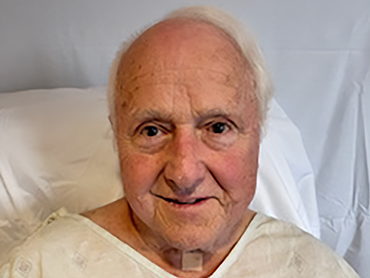
Each day, Fred’s care team got him out of bed and into a chair to improve his core strength. They did bedside exercises with his arms and legs. Respiratory therapists worked to improve his lung capacity by gradually reducing the amount of oxygen he received. A speech-language pathologist connected a special valve to Fred’s tracheostomy tube that pushed air through his vocal cords, allowing him to speak for the first time in a month.
“Progress was slow, so little changes were really, really big for us,” explained their daughter, Tabby.
With Fred’s physicians, nurses, aides, therapists and others working together, he soon hit four milestones.
Fred was able to sit on the edge of his bed without assistance.
He was able to breathe on his own and the tracheostomy tube was removed.
As Fred became more alert, he recognized the steady stream of family members who were by his side daily, helping to keep his mind, body and spirit in good shape.
“When he got to watch (a church service) we had a feeling then he was coming out of it,” Darlene said.
And, he was able to slowly start eating again after passing a special test that demonstrated he could swallow without aspirating. His feeding tube was removed.
Darlene was especially encouraged when Fred started asking to do things like go to the bathroom, or when she watched him shave and brush his teeth.
“It was fun to see him as he was becoming more alert, blowing kisses and telling the staff that he loved them,” Darlene recalled.
Three weeks after admission, Fred had made enough progress to advance to the next step in his recovery journey -- an inpatient rehabilitation hospital. There, he continued to work on strength and mobility, overcoming setbacks along the way.
Six months later, with her father back home, Tabby reflected on his time at Select Specialty Hospital.
“We didn’t understand what a long-term acute care hospital was or where it fit in the process of his recovery, she said. But, she remembers how the staff would help her father out of bed and into a chair every day – an important first step in rebuilding strength and laying the foundation for future therapy.
“Sometimes we wondered, is he healing? It was hard to see progress,” she said. “But each little thing he did was progress and we learned to celebrate the little things, like opening his eyes or talking again for the first time.”