Fighting her way back from Guillain-Barré syndrome
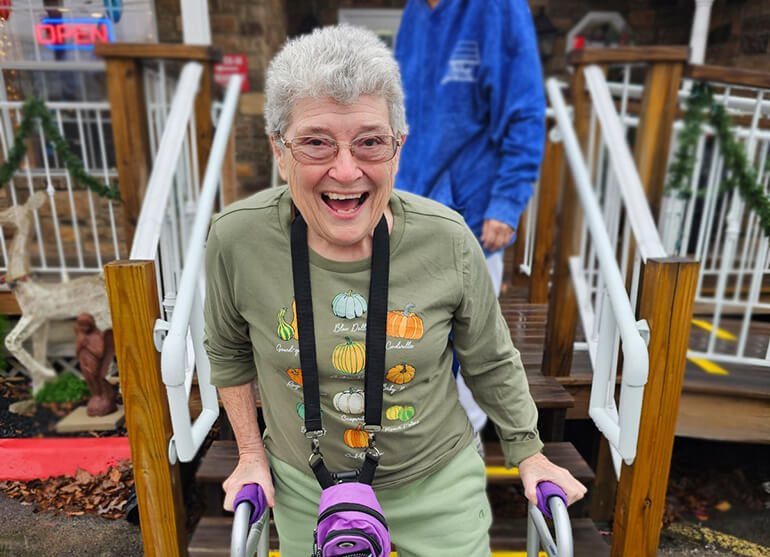
Thanksgiving isn’t Thanksgiving for Paulette Crawford’s family without her near-famous dressing. Last November, as the 73-year-old Missouri woman fought her way back from the paralyzing effects of Guillain-Barré syndrome, her daughter-in-law assumed she’d be the sous chef concocting the dressing.
“I went to Paulette’s house to learn how to make it and there she was, holding herself up at the sink, making it,” Lisa Garbiel said. “She wouldn’t let me do anything.”
That’s Paulette. She always had everything covered, whether it was mixing the right amount of bread crumbs to finely-chopped celery or facing down the crisis that stopped her in her tracks exactly one year earlier.
Thanksgiving weekend the previous year, Paulette suddenly couldn’t feel her legs. It didn’t make sense; just a day before she’d been working in her yard. A friend drove her to the hospital and by the time they arrived, Paulette couldn’t walk. Within days, she could only move her face. Paulette spent the next three months in three hospitals.

“She couldn’t get up out of the bed, couldn’t move her limbs at all.”
“All I had was my ears and my eyes”
Guillain-Barré syndrome is a rare neurological condition where the body’s immune system attacks its nerves. In severe cases like Paulette’s, limbs are paralyzed. Paulette underwent intravenous infusion therapy at SSM Health St. Clare Hospital. A few days later, she moved to a skilled nursing facility for rehabilitation but soon after arriving, Paulette aspirated applesauce she was being fed, meaning some of it went into her lungs. She returned to St. Clare in acute respiratory failure and septic shock.
Physicians intubated Paulette, connected her to a ventilator and admitted her to intensive care.
Paulette doesn’t recall a lot from those early days, except for being completely paralyzed.
“All I had was my ears and my eyes,” she said. Paulette communicated by blinking in response to flashcards.
“She couldn’t get up out of the bed, couldn’t move her limbs at all,” Paulette’s daughter Kimberley – Lisa’s wife – explained. Still, “She’d smile when we talked with her.”
For the next 16 days, as Paulette’s care team treated her with fluids and medication, Kimberley researched her mother’s next step in recovery.
Paulette’s family chose Select Specialty Hospital – Town and Country, a critical illness recovery hospital in St. Louis, Missouri, known for helping patients learn to breathe, eat, talk, walk and think clearly again. Paulette arrived on a gurney and couldn’t do any of those. She had a tracheostomy, a slit in her windpipe with a tube that connected to a ventilator.
“Getting her off the ventilator, that was a huge, huge step for us,” Lisa said. “We had high hopes, but it was a lot of ‘two steps forward, one step back.’”
Every day, Paulette participated in breathing trials where respiratory therapists took her off the ventilator for increasing amounts of time and monitored her ability to breathe on her own.
“Some days she would do great on a trial and some days weren’t as good,” Lisa said. “But every little gain was one step closer to her getting off the vent and eventually it happened.”
Kimberley remembers that day well. “Oh my God, we were calling everybody, we were so happy,” she said. “For the first time, we were moving in a good direction.”
Achieving milestones
Paulette hadn’t been able to speak for six weeks. Now that she was off the ventilator, a speech-language pathologist connected a special valve to Paulette’s tracheostomy that moved air through her vocal cords allowing her to speak.
Kimberley’s sister, Stephanie, got the most wonderful – albeit startling – surprise when she walked into her mother’s room.
“Hi Steph.”
Paulette began making other big gains. After passing a special test where she demonstrated she could swallow without aspirating, Paulette began eating by mouth again, starting with pureed blueberries and applesauce and progressing to a regular diet.
Meanwhile, Paulette’s care team got her out of bed and into a chair every day to help rebuild her muscles and stamina. Therapists massaged and moved her arms, hands, legs and feet, which were still stiff and now severely deconditioned from her illness. Paulette had always loved drawing and painting but her fingers were locked in a fist.
Therapists fitted Paulette with a strap that wrapped around her hand and could hold objects, such as a colored pencil or toothbrush. Paulette practiced writing her daughters’ names.
Six weeks after admission, Paulette could breathe, eat and talk. She was slowly regaining movement in her arms and legs. She could sit on the edge of the bed.
“They tried to stand her up a couple of times but she could not lift herself,” Kimberly said.
When she could tolerate three hours of therapy a day, she moved to an inpatient rehabilitation hospital to continue her journey toward independence. A month later, she buzzed out of the hospital in an electric wheelchair.

A continuing journey
Eight months after she made it home, Paulette continues to recover. She participates in a full day, specialized outpatient rehabilitation program at SSM Health Day Institute in Arnold with a goal of getting back to the busy life she led before Guillain-Barré syndrome got in her way.
Her first day at the program, therapists gave her a board with nine holes and asked her to put pegs in the holes and pull them out again as a test of the dexterity in her fingers. In three minutes, she moved two pegs.
Today, she can do all nine in 30 seconds.
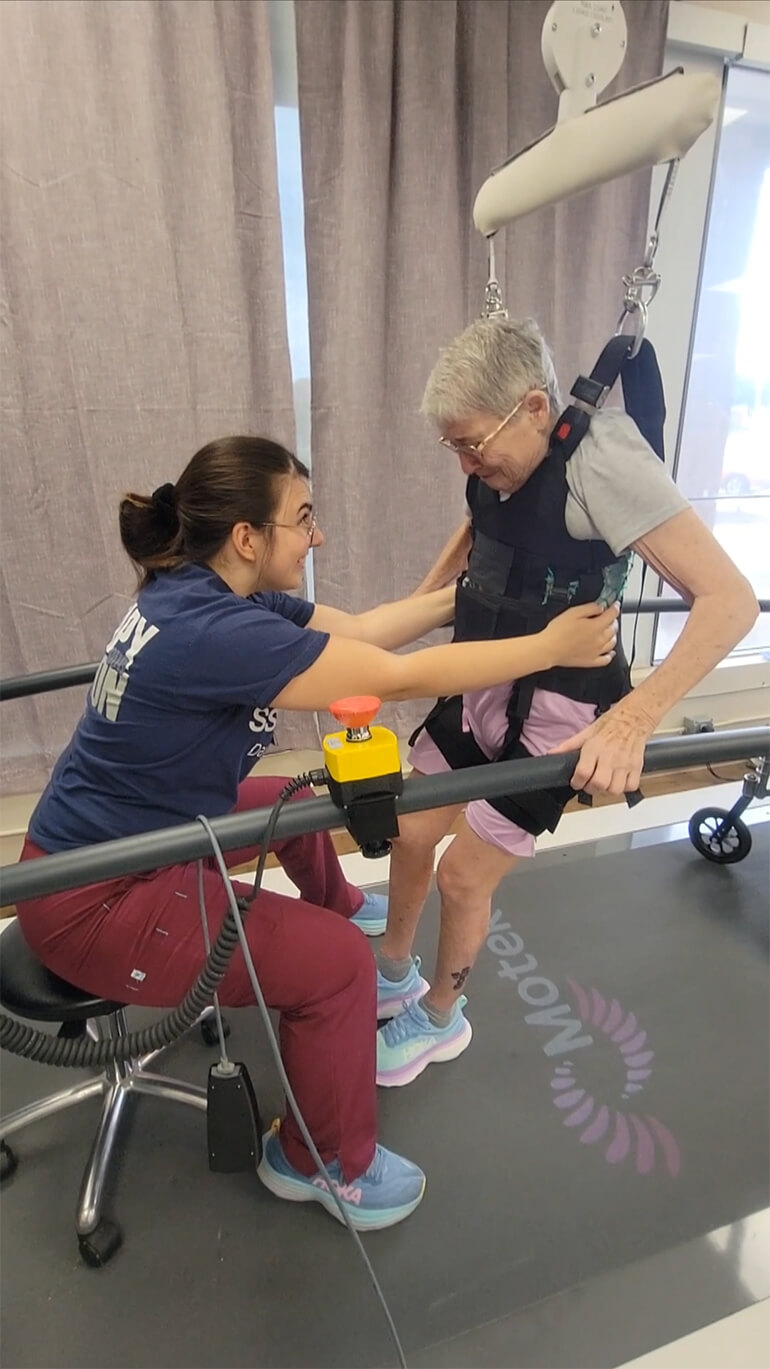
She took her first steps at the day program. “They stood me up in a machine with a jacket that holds you and I was moving my feet, actually trying to walk. That was a big milestone,” she said, one that brought tears of joy.
So also was the day six months later when she walked 200 feet with a cane. Her therapists made a finish line with blue tape on the floor and videotaped her crossing it.
Her family has photographs and videos of all her milestones. It’s a way to look back and see how far she’s come.
“We could have lost her,” Lisa said. “We were close to losing her.”
Kimberley agrees. “She’s a fighter. She always has been. She’s one of the strongest women I’ve ever met in my life and she refused to let this take her down.”
Today, Paulette can wash, feed and dress herself. She can grasp a thin paintbrush and make tiny strokes. With her daughters’ help, she’s getting out in the community. And, she can make the Thanksgiving dressing.
She’s grateful to her family, friends and the health care teams who rooted for her every day.
“I always had positive vibes around me and that helped me more than anything,” Paulette said. “We talk about the importance of that at rehab. You have to leave the negativity at the door.”