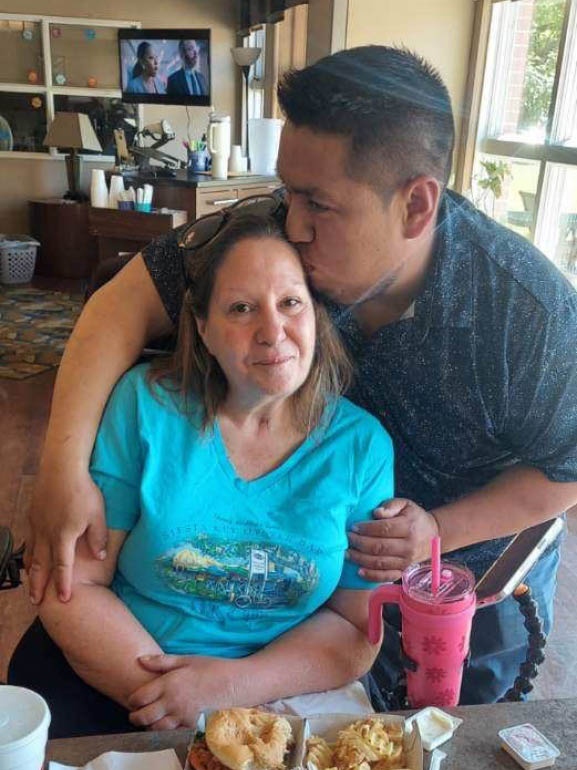
A Missouri woman’s comeback from Guillain-Barré Syndrome: ‘I took that ounce of hope and ran with it’
Christine Rallo started the week with the symptoms of an upper respiratory infection – congestion, sore throat and headache. The 59-year-old paralegal tried to fight them off, working from home every day and relaxing at night. By the weekend, she was feeling better and back to her normal rhythm. But when she woke up Sunday morning to heavy tingling and numbness in her legs and struggled to walk to the bathroom, she knew something wasn’t right.
“I had to hold on to the dresser, the bed post, the sink, as I walked,” she remembered. “When I got back to my bedroom, my legs collapsed and down I went.”
Unsure what was happening, her significant other called an ambulance, which transported her from her home in Maryland Heights, Missouri, to Mercy Hospital St. Louis. The first doctor to assess her quickly recognized she had Guillain-Barré Syndrome, a rare condition in which the body’s immune system mistakenly attacks the nerves causing weakness and paralysis.
“I was shocked. I thought I would get a shot and they’d send me home,” Christine said, remembering the many tests that followed. “Guillain-Barré starts in the lower limbs and progresses upward. It can stop anywhere. Unfortunately for me, by 8 p.m. I was paralyzed up to my shoulders.”

Every breath was a battle
As it became more difficult for Christine to breathe, doctors placed her on a ventilator and admitted her to the intensive care unit. She eventually needed a tracheostomy for long-term breathing support and a feeding tube for nutrition.
“The doctor told my family that I had such a severe case of Guillain-Barré that they didn’t think I’d make it,” she said.
Despite that warning, Christine’s condition stabilized during her 20 days at Mercy Hospital, but she still was dependent on the ventilator, trach and feeding tube. With her sister advocating for her care, she transferred to Select Specialty Hospital – St. Louis, a critical illness recovery hospital known for successfully treating Guillain-Barré patients that is located within SSM St. Joseph Hospital.
Shortly after Christine arrived, her physician-led multidisciplinary team developed a personalized treatment plan to help liberate her from the ventilator and regain her ability to talk and eat.
“I could not feel from the neck down,” she remembered. “I was aware of what was going on around me, but I couldn’t talk, eat, walk, use the bathroom or do anything on my own.”
Christine’s treatment began with an infusion of healthy donated immune system antibodies for five days that were meant to block the harmful ones attacking her nerves. But before it could help, her lung collapsed. When her heart rate dropped sharply, physicians at SSM St. Joseph Hospital implanted a pacemaker.
“The doctor told my sister to call in any out-of-town family members and to talk to me about my last wishes,” she said. “For the next day or two, I was just making peace with death.”
Hope for recovery
Then, Christine’s brothers explained that many people fully recover from Guillain- Barré, telling her that if she wanted to survive, she’d have to fight for her life.
“I took that ounce of hope and just ran with it,” she said. “I went from not knowing if I would survive to fighting to get my life back.”
Christine returned to Select Specialty Hospital after the placement of the pacemaker. Her respiratory therapists immediately began breathing trials in which she breathed without a ventilator for increasing amounts of time. Each day, Christine’s breathing improved. In one month, she was able to use a Passy-Muir valve and speak for the first time since being hospitalized. Just two days later, she was liberated from the ventilator, reaching a milestone at one point she thought was impossible. Her tracheostomy was removed three days later.
“With the talking valve, I was able to express what I was feeling,” she said. “Prior to that the only way I could communicate was with a letter board, where someone would point to each letter and I would nod yes when they reached the one I wanted.”
Milestones keep coming
At the same time, Christine’s speech-language pathologist guided her through exercises to strengthen her throat muscles so she could eat again. Twenty-five days after she arrived, a special study confirmed she could safely swallow, and she started a diet of soft foods and thin liquids. Six days later, she returned to a regular diet although she needed someone to feed her.
“I was like a kid in a candy store,” she recalled of those first bites of applesauce. “I was euphoric.”
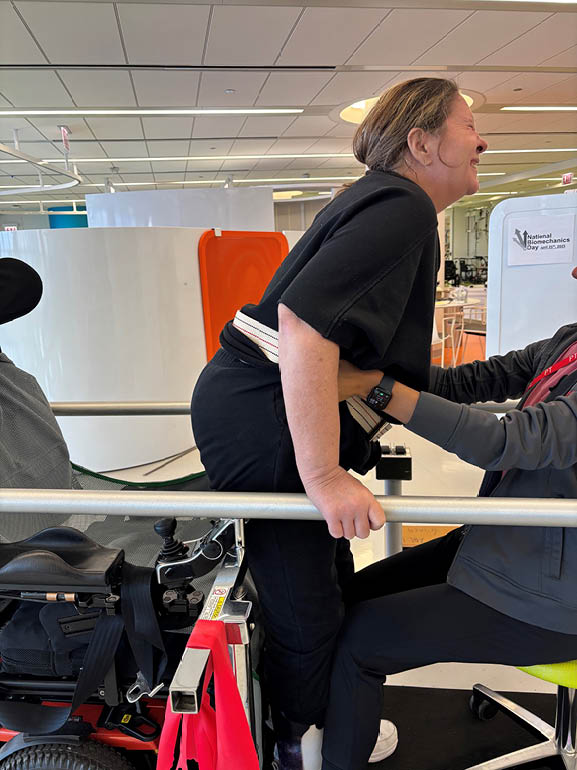
Christine’s physical and occupational therapy teams played an important role in helping her regain movement. When she first arrived, she could only move her head. Physical therapy began with basic bed mobility before progressing to chair transfers, but pain was a major obstacle as feeling returned to her arms and legs.
“My therapists would tell me, ‘We need to get you up and moving. You need to be tough,’” she said. “Everything they told me to do was painful, but I knew if I wanted my life back, this was what I needed to do.”
By discharge, Christine could move in bed with maximum assistance, though a lift was still needed to transfer her to a wheelchair. Once seated, she could travel five feet using both arms to propel herself forward.
Occupational therapy also supported her progress, helping her transition from needing maximum assistance with self-care when she arrived to showing signs of improvement by the end of her stay.
A new outlook
After 38 days at Select Specialty Hospital, Christine had made remarkable progress and was ready to transfer to an inpatient rehabilitation facility.
“My doctor was amazed,” she said. “He kept saying, ‘This is a miracle. You’re making strides quicker than expected.”
Grateful for the staff’s steady encouragement, she added, “My therapists brought so much joy to me with their personalities. As caregivers, they were spectacular.”
Following five weeks of inpatient rehabilitation and four months in a post-hospital rehab center, Christine returned home able to walk and care for herself. Though Guillain-Barré still affects her ankles and feet, she continues to improve and has found new purpose in the life she fought to reclaim.
“I truly believe God allowed me to live for a purpose,” she said. “I’m finding that purpose is to motivate and encourage others facing life-threatening disabilities – to advocate for them, motivate them and inspire them.”