Lazarious' Story

After “lots of ups and downs” during eight-week hospitalization, Florida dad is back home
For three weeks, Sierra Reeder was a fixture at her husband’s side. Lazarious “Laz” Reeder was fighting for his life in the intensive care unit at Ascension Sacred Heart Hospital in Pensacola, Florida.
Sierra, a new, first-time mother, had to make the heart-rending decision to hand their 6-month-old daughter to her sister so Sierra could be with her husband.
The Reeders are people of deep faith. Easter Sunday, Sierra went to church.
“As I’m leaving church, I get a call and a voice says, ‘Hold on, someone wants to speak to you.’ And it’s a man talking to me, and I’m thinking it’s the doctor,” Sierra said.
The voice said, “Happy Easter.”
“Then I realized it was my husband,” Sierra said. “I hadn’t heard him speak for 30 days.”
Aspiration leads to respiratory failure
Laz, 35, who works within Escambia County Board of County Commissioners’ human resources office in Pensacola was born with a congenital diaphragmatic hernia. His diaphragm - the muscle separating the chest and abdomen – did not fully form, allowing abdominal organs to move into his chest cavity, crowding his lungs and heart. Laz underwent two surgeries to address the condition but frequently dealt with reflux.
Recently he’d developed an umbilical hernia – a bulge in his belly caused by tissue that broke through the intestinal wall – and now faced a third surgery. For most patients, this surgery is not complicated.
But as Laz’s medical team began administering anesthesia, he aspirated and his stomach contents went into his lungs, causing acute hypoxic respiratory failure. His lungs could no longer provide enough oxygen to his blood. Laz was intubated, connected to a ventilator and moved to intensive care.
When he still wasn’t getting enough oxygen on the ventilator’s highest settings, Laz was connected to extracorporeal membrane oxygenation (ECMO), a life support system that takes over the work of a patient’s heart and lungs so they can heal. EMCO pumps blood outside the body, adds oxygen, removes carbon dioxide and returns the oxygenated blood to the body.
“I was very thankful we were at that hospital,” Sierra said. “It’s the only one in the area that has that machine.”

Laz Reeder spent nearly a month at his first hospital, much of it in intensive care.
Sierra’s eyes moisten when she recalls the vision of her husband lying unconscious, connected to a maze of machines. As she sat in his room praying for recovery, she watched as the ECMO team quietly monitored Laz and a separate team of ICU doctors and nurses came in and out of the room. Alarms sounded constantly.
“Nobody was talking but they were speaking with their eyes. I was freaking out inside,” Sierra said.
When she finally mustered the courage to ask if Laz was okay, nurses assured her that if anything was wrong, they would tell her. His recovery would be a rollercoaster of ups and downs.
Sierra told them, “I need him, y’all. I need him.”
Research shows that four out of 10 patients who go on ECMO do not survive. Laz did. And while he battled numerous complications over the next three weeks, his lungs began to heal and he could breathe without a ventilator. He was able to speak again, saying his first words to his wife that Easter morning.
Road to recovery
One month after he walked into Sacred Heart for what he thought would be routine surgery, Laz was ready to leave ICU care but was far from being strong enough to go home. While therapists had gotten him on his feet, he lacked stamina to walk more than a few steps. He couldn’t eat; he was fed through two tubes, one in his abdomen and one intravenous. He couldn’t care for himself.
“It was a lot of work to even get me out of bed,” Laz recalls, noting that his right leg was particularly weak and he couldn’t straighten it.
The family made the decision to transition Laz to Select Specialty Hospital – Pensacola, a critical illness recovery hospital where a physician-led, multidisciplinary team could help Laz continue his journey to get home.
Laz arrived with a tracheostomy (trach), a slit in his windpipe with a tube that had once connected to a ventilator and later, provided supplemental oxygen as his lungs healed.
His first milestone at Select Specialty Hospital came three days after admission when the respiratory team determined he no longer needed that trach and it was removed.
Laz worked to regain strength through progressively more difficult exercises – resistance bands, weights, a stationary bike, an arm bike, walking short distances with a walker and more.
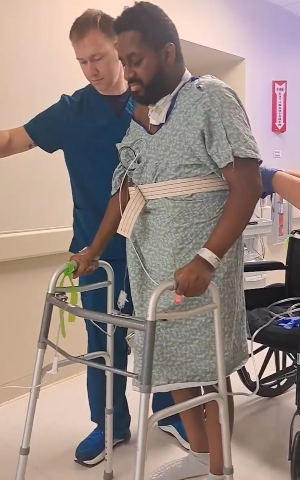
At Select Medical Rehabilitation – Pensacola, Laz regained the strength, movement and independence.
He also practiced self-care activities such as brushing his teeth, feeding himself and going to the toilet.
A week after admission, Laz passed a special test demonstrating he could swallow without aspirating. A gastrointestinal doctor approved him to begin consuming food by mouth again, starting with clear liquids.
And Laz’s favorite moment at Select Specialty Hospital, when he declared himself “the happiest person alive” was when his wife came with baby Nyla and while seated in his wheelchair, he held his precious daughter for the first time in five weeks.
Final push to get home
Thirteen days after admission to Select Specialty Hospital, Laz was ready to begin more intensive rehabilitation. He transitioned to Select Medical Rehabilitation – Pensacola, an inpatient unit located within the hospital.
He practiced walking longer distances and on different kinds of surfaces. He carefully climbed stairs. He participated in more balance exercises, like tossing and catching a ball.
Perhaps his most meaningful therapy was preparing to be a dad again at home. Wrapping a dumbbell in towels to simulate Nyla, he practiced picking up and lying down his daughter, changing her diaper and passing her back and forth to Sierra.

At Select Medical Rehabilitation – Pensacola, Laz regained the strength, movement and independence.
“The therapy department has been a huge part of my success,” Laz said. Rehab was hard and at times, scary. “Sometimes I’d think, ‘Oh God, do I have to do this?’ and they’d get me through my comfort zone.”
Sierra added, “The care they give you at Select is so personal. It is so tailored to that patient. I really admired that they found stuff that worked for him and it all fell into place.”
Eleven days after he began rehabilitation, Laz walked 150 with rolling walker. He could shower, feed himself, dress and do most other self-care tasks.
He discharged home with Sierra and Nyla after and looked forward to spending time with his three older children, going to church and out for a pancake breakfast.
“I experienced lots of ups and downs, but during those times I learned a lot about myself and just how strong of a person I could be. My faith has helped me to overcome all that I have been dealt during this hospital admission,” Laz said.
And, he’s in awe of his wife.
“I have gained even more respect and love for both my wife and my family. (Sierra) has been here with me seven days a week, even though she had her other responsibilities with our daughter, the house and a job. My wife had to be both mom and dad during my absence. She has been my rock that continued to push me to improve more every day.”