Angela's Story

“I want to live”
Angela Fawley had just celebrated her 50th birthday. The wife and mother from Repton, Alabama, assumed the growing weakness in her neck and shoulders must be due to aging.
Then Angela was cleaning a home and didn’t have the strength to raise her arms to wipe a bathroom mirror. She fell and couldn’t get up; she used her elbows to pull herself to the sink.
“Still, in my brain, I’m thinking, I’m older, I’m just having a bad day,” Angela recalls.
Angela was about to have several months of bad days. She had Guillain-Barré syndrome, a rare condition in which the body’s immune system attacks the nerves, causing muscle weakness and in Angela’s case, complete paralysis.
Originally misdiagnosed
Angela was initially misdiagnosed with arthritis and sent for physical therapy. The therapist realized something more was wrong.
When Angela went for a neurostudy, she couldn’t get off the table at the appointment.
Additional tests including a spinal tap revealed Guillain-Barré. Angela was hospitalized at Springhill Medical Center in Mobile, Alabama, to undergo intravenous immunoglobulin (IVIG), a treatment that involves administering antibodies into the bloodstream. Eight days later, she walked out of the hospital.
But within days, she began struggling to do little things again. Then she collapsed.
Angela was back in the hospital, this time for 7 ½ weeks. She was completely paralyzed. The first few weeks she underwent more IVIG treatments, high dose steroids and plasma transfusions. Then Angela choked on mashed potatoes – the result of the progression of her illness – and ended up in the intensive care unit (ICU) and on a ventilator.
Terrifying memories
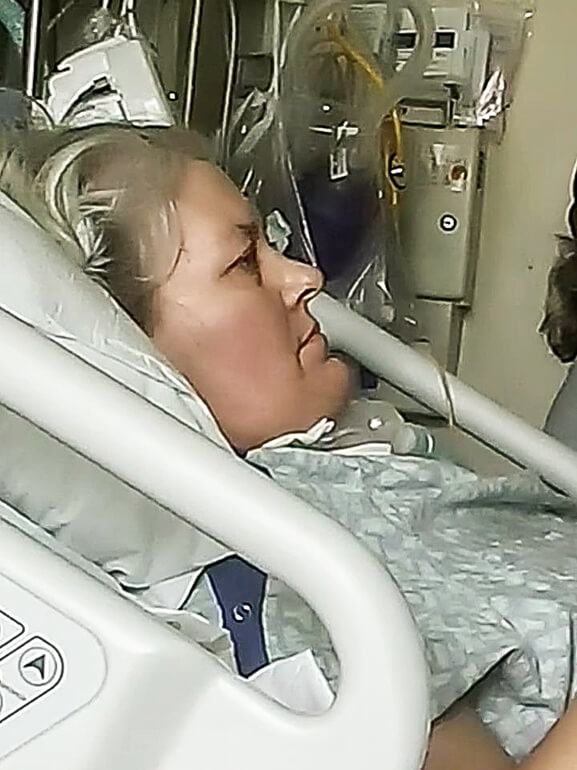
Those days are hazy memories for Angela but she recalls with clarity how terrifying it was to lie in the ICU, unable to move any part of her body beyond her face, unable to speak because of the breathing tube that kept her alive. She couldn’t press a button for help; her only communication was through her eyes and facial expressions.
She remembers how her skin felt on fire, so much so that her room was kept at 64 degrees and a fan blew air at her. Her husband, Scott, and her mother rubbed her face with ice cubes.
Angela couldn’t tolerate light, sound or touch – beyond the ice cubes. She loathed when nurses had to turn her to prevent pressure sores.
While Angela’s personality is typically sunny, “Dark and cold, that’s how I wanted it. Everything else aggravated me.”
One of the hardest days for Scott was when he had to make a decision whether to allow physicians to give Angela a tracheostomy – a slit in her windpipe that connects to a ventilator – as well as a feeding tube and a PICC line that delivered medication to the large veins near her heart.
Scott was concerned Angela would upset with him for consenting to the treatment, even though they were important for her survival. His fears were alleviated when Angela finally had a day where she could think clearly and he explained what had happened.
“She moved the tube over just enough to mouth to me, ‘I don’t want to die,’” Scott said.
Angela’s progress was baby steps at Springhill but eventually she stabilized and her skin stopped burning. Angela won her fight for survival; now began her battle for independence. For that she transitioned to Select Specialty Hospital – Pensacola, a critical illness recovery hospital.
At admission, Angela was able to wiggle her toes but her arms and legs remained paralyzed. Her hands had stiffened like claws, even though the team at Springhill put rolled up washcloths in her palms to prevent that. She was still on a ventilator and feeding tube and still couldn’t speak.
From day one, her physician-led multidisciplinary care team collaborated on one goal: helping Angela get back to the active lifestyle she led before her illness.
Achieving milestones
Angela’s respiratory team began breathing trials immediately that involved taking her off the ventilator for increasing amounts of time so that her lungs had to do more of the work.
She bonded immediately with her therapists.
“They were so kind and whatever they told me to do, I did it,” Angela said. “I didn’t want to be on that trach anymore.”
A speech-language pathologist connected a special valve to Angela’s tracheostomy tube that pushed air through her vocal cords again.
She laughs as she remembers how, upon being able to speak again, she wasn’t sure what to say. Her husband was in the room.
“You spent all this time being unable to speak and now you don’t know what to say?” he jested with her.
She told him and her mother – two people who were by her side day after day -- that she loved them.
Eleven days after admission, Angela no longer needed the ventilator. Ten days after that, her tracheostomy was gone.
She also passed a special test demonstrating she could swallow without aspirating. “When they gave me ice chips, it was the best thing ever,” she said. “I could only have them every so often and so I watched the clock.”
Angela progressed to thick liquids, soft foods and eventually, real food. Her first meal from the hospital was shrimp. “I don’t even like shrimp but they were so good,” she said.
The next day, it was fried chicken from Publix.
One of Angela’s favorite memories was when her therapists arrived at her room with a large chair.
“They said, ‘We’re getting you up today,’” Angela said. She still couldn’t move her limbs so therapists used a Hoyer lift to get Angela in the chair. It felt amazing to be upright and out of bed. “After that, I wanted to be in the chair all the time.”
That day marked the beginning of a new chapter in her recovery.
Transitioning to inpatient rehabilitation
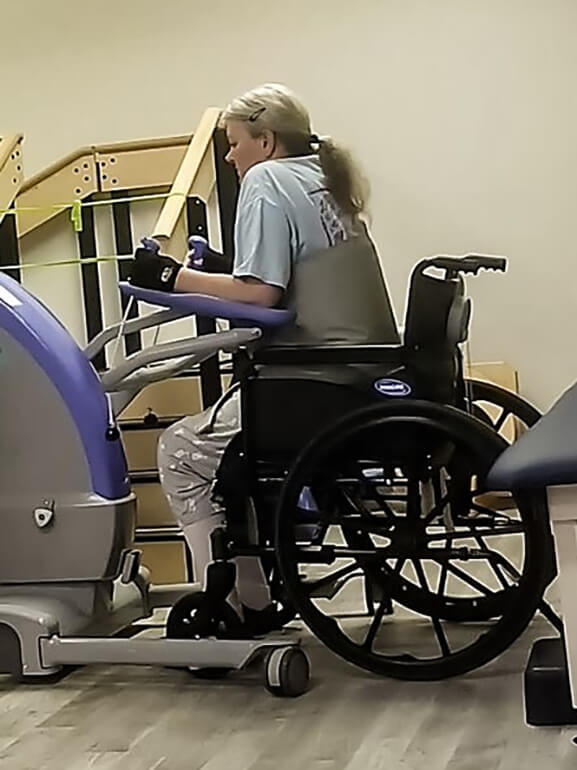
Ever since Angela arrived at Select Specialty Hospital, therapists and nurses and her family continually moved her arms, hands, legs and feet to reduce the stiffness and restore motion. By week three, Angela began regaining movement.
She transitioned to Select Medical Rehabilitation – an inpatient rehabilitation unit located within Select Specialty Hospital. Here, her focus shifted to mobility and self-care.
“You would think touching your nose would be so easy but I couldn’t do it,” Angela said. “I’d stare at people doing things that were so easy for them – like getting up from sitting to standing or brushing their teeth – but impossible for me.”
Angela had three hours of therapy every day. In the early days, when she still had little muscle control, she practiced moving from her bed to a chair using a board or holding herself upright at the edge of her bed. When she mastered that, her care team helped her to stand. A week later, she took her first steps with a rolling walker.
As she progressed, Angela rode a stationary bike and did squats – lots of squats.
“Squats hurt so badly but without them, I don’t think I would have ever gotten up,” she said. “I still do my squats today.”
Every day, Angela’s goal was to do something she hadn’t been able to do the day before: lift her leg higher, touch her toes, put her socks on or pull her hair into a ponytail.
And in occupational therapy, Angela practiced for a new role that lay ahead … grandma.
“My son and his wife were having their first baby and my goal was to hold my grandbaby,” Angela said.
Angela’s occupational therapist, Amy Fossa, used a 7-pound dumbbell and swaddled it in towels. She and Angela practiced passing it back and forth to make sure Angela could support the weight and extend her arms. Then Angela practiced standing and holding and bouncing the “baby” on her hip while using her other hand to do other activities, challenging her balance and endurance.
As Angela got comfortable, Amy used bolsters and pillows to simulate a crib and Angela had to lay the “baby” down and pick it back up, making sure she could control the weight as she bent over and stood back up.
“She worked really hard at everything we challenged her with and this was definitely a role she obviously valued a lot,” Amy said. “It was great to watch her building her confidence while getting ready to go back home and welcome her grandbaby.”
Heading home
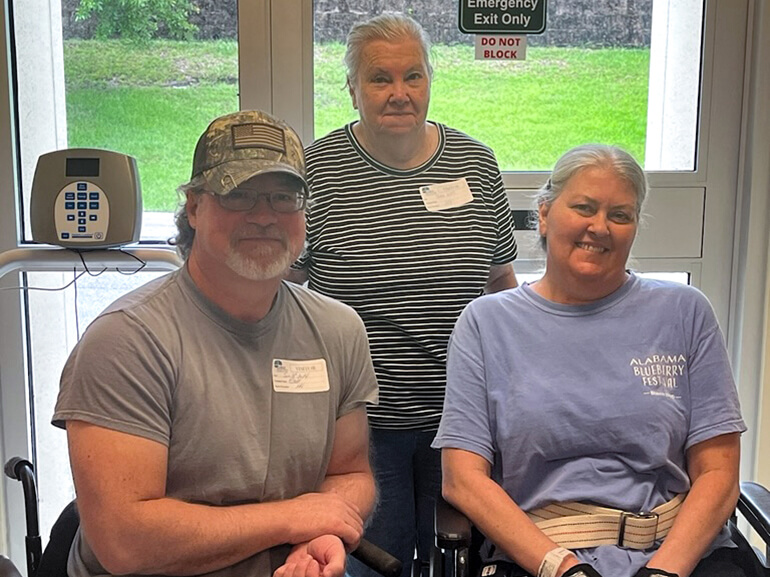
Eight weeks after Angela arrived at Select Specialty Hospital on a gurney, she left Select Medical Rehabilitation for home able to walk short distances with a walker. She could take a shower, get dressed, brush her teeth and make herself breakfast.
Leaving was harder than she expected. “Of course I was excited to go home, but I was going to miss these people who had become like family.”
For Scott, watching Angela’s recovery was “like when you are watching a good movie and you try and guess the ending,” although as a man of faith, Scott said he trusted God with the finale.
Angela went to outpatient physical therapy to continue her recovery and is now back to her active lifestyle, even running short distances again. She approaches every day with gratitude, remembering that not so long ago, she lay in a hospital bed unable to move, a breathing tube down her throat, her skin burning like fire and terrifying thoughts consuming her consciousness.
Most of all, she’s enjoying life as a grandmother.
When Angela and Scott got the phone call that baby Ellie was born, they took off for Mobile. Angela was still using a cane to walk.
“Twenty minutes into the trip, she looks at me and says she forgot her cane,” Scott said. “I said, ‘Let’s go get it’ and she said, ‘No, we’ll manage.’”
Angela never used that cane again.