Stacy's Story

Writing her next chapter after a life-changing illness
Stacy Wilhelm vividly remembers walking through a haze of thick gray smoke and hearing a sneering voice say to her, “Why would you want to stay here?”
“My family,” Stacy said in reply.
No response.
She said it again, a little louder: “My family.”
Still no response.
Then Stacy yelled it, “MY FAMILY,” waking herself in the intensive care unit at Baylor Scott & White All Saints Medical Center in Fort Worth, Texas, where for weeks she had been teetering between life and death.
Stacy’s family – husband Damian and their three kids – wanted Stacy to live as much as she did. Throughout her 119 days among three hospitals, one or more of them were always by her side, even overnight.
It all started when Stacy, 55, of Amarillo, felt a little off though she was juggling a lot of roles: high school teacher, best-selling author, mom and wife.
Then Stacy awoke one night struggling to breathe. Damian drove her to an urgent care, which led to the emergency room at BSA Hospital in Amarillo. The diagnosis shocked her: Stacy was in congestive heart failure. She had stenosis as well as an aneurysm (a bulge in a blood vessel) in her aortic root. She needed open heart surgery to replace the damaged part of her aorta, including the valve.
“And then the rest of me just fell apart”
Stacy was born with a bicuspid aortic valve, a congenital heart defect where the valve, which normally has three flaps, had only two. She was followed by cardiologists until age 18 when she was told her body had compensated for the anomaly and she was fine.
“They said, ‘Go on and live your life,’” Stacy said.
And so she did, until now. She was told a lingering heart murmur led to her current condition. She was treated for fluid on her heart and went home to await surgery. That night, her leg felt numb, and Stacy was back at the hospital for emergency surgery to clear a blood clot from her aorta.
Days later, she made the five-hour trip from home to All Saints where she underwent open heart surgery. The surgeon told Stacy and her family that the aneurysm was the worst he had seen and the surgery had been challenging – but she survived. She expected to be in the hospital a week and back to work in six weeks.
“And then the rest of me just fell apart,” Stacy said.
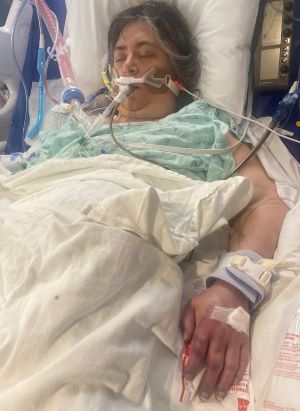
Stacy spent five weeks at Baylor Scott & White All Saints Medical Center battling complications following heart surgery.
Pneumonia. Kidney failure. Low blood pressure. She was on and off a ventilator, needed dialysis continuously and her body doubled in size from fluid retention. Additionally, her left hand and both feet were turning black, the result of medication that diverted blood from her limbs to her organs.
She later learned that some days – sometimes multiple times a day – her family prepared to say goodbye.
Recovery gets underway
Stacy spent five weeks at All Saints fighting for life. In and out of consciousness, she remembers the day doctors explained that they needed to remove her left hand because it was dead from gangrene. Privately, they told her family she might lose her feet, too.
“I thought, ‘Well, there goes playing the piano, playing the guitar and typing,” she said. “But then I thought, ‘It’s either that or you’re going to die.’”
Eventually, she began to improve. Tubes were removed; the maze of intravenous lines dwindled.
Her biggest challenge was that she couldn’t breathe without a ventilator.
She transitioned to Select Specialty Hospital – Dallas Plano, a critical illness recovery hospital known for helping patients get back to breathing on their own. By the time Stacy arrived, she had a tracheostomy, a slit in her windpipe, with a tube that connected to the ventilator to help her breathe. She couldn’t eat or talk. She communicated with her family through finger spelling, a type of sign language. Her feet were covered in blisters. She was too weak to sit, stand or walk.
A physician-led, multidisciplinary team collaborated to help Stacy return to her family, students and writing.
First up was respiratory therapy. Stacy had pleurisy, an infection in the lining of her lungs that causes severe chest pain. Tubes were inserted in each lung to drain fluid. Her airways also flooded with mucus – “I felt like I was drowning” – requiring frequent suctioning.
Stacy’s care team wanted her upright to improve her respiratory and circulatory challenges. Sitting on the edge of the bed or in a specialized chair required a team to support her and all her medical equipment and it made a difference. Two weeks into her stay at Select Specialty Hospital, Stacy was still on the ventilator but ready to begin breathing trials.
“You would think weaning would be a pretty straightforward process, but it is not easy,” she said.
The care team reduced the settings on her ventilator for increasing amounts of time so her lungs had to do more of the work, starting with two hours and working upward to 24 hours. Sometimes she couldn’t finish the session and had to start over at two hours.
“I got frustrated for how long it took … was I ever going to get out of there and back to something resembling life?” she said. “But everyone kept working with me and encouraging me.”
Stacy still communicated with her family and care team through finger spelling or – in the case of Damian, who wasn’t very good at that – writing on a white board.
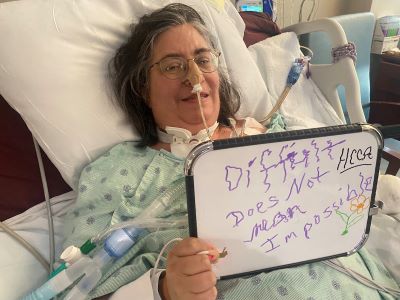
A message Stacy has shared with her students took on new meaning in her own battle.
“It’s a helpless feeling to not be able to talk,” she said. As an author who has published 75 books under the pen name Staci Stallings, her self-description is, “words are my life blood.”
But having to finger spell every letter of every word may very well be the reason Stacy still has her right hand; she constantly used that arm, hand and fingers, promoting blood flow.
Achieving milestones
As Stacy’s stamina improved in the breathing trials, a speech therapist attached a special valve to her tracheostomy that pushed air through her vocal cords, enabling her to speak again for the first time two months. The valve also strengthens the respiratory system. Her first words? “I want a cheeseburger and vanilla pudding.”
Days later, the ventilator was gone. Then doctors removed the tubes in her chest and shortly after that, they capped her tracheostomy to see how well she could breathe on her own.
Stacy never needed the tracheostomy again and it, too, was removed.
Through it all, Damian was there every day, even sleeping on a cot in the room with her while her kids took turns making the 365-mile each-way drive from Amarillo to Dallas. Sometimes they’d bring bags of cards from her students at Holy Cross Catholic Academy, where she teaches English, creative writing, life skills and quantum growth.
Her blisters were healing and so, too, was the incision where her hand was amputated. Dialysis was now every other day for four hours. She was cleared to eat ice chips.
Stacy was also getting stronger through her physical therapy.
“Raise your leg. Raise your arms. Do circles with your ankles. Sit on the edge of the bed but look up, raising your chin,” Stacy recalls all the exercises and instructions.
Damian repeated many of those movements with her throughout the day.
Soon – with two people beside her and one in front – Stacy stood for the first time. “Well, I couldn’t really call it standing,” she laughed. “It was more of a lazy squat. I couldn’t get all the way up.”
Then she was able to do it again, more upright, and stayed there for 45 seconds.
“Everyone was going crazy that I was doing so good,” she said.
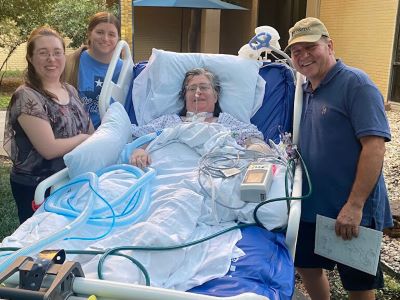
Stacy’s family was a constant source of encouragement.
Moving to inpatient rehabilitation
Six weeks after admission, Stacy discharged from Select Specialty Hospital for inpatient rehabilitation at a hospital in Amarillo. She was there for two days and even enjoyed her first real meal since her ordeal began. Then trouble struck again – she got pancreatitis, a painful inflammation of the pancreas. She celebrated the week after Thanksgiving with gall bladder surgery.
But 41 days later, Stacy made it home. She could walk with a walker, albeit slowly. She was still learning to navigate life as an amputee, with the help of a caregiver who came to the house. She could eat again. She was already starting to think of storylines for her next novel, although she hadn’t yet figured out how she would convey the story now with only one hand.
Best of all, she and Damian awaited the birth of their first grandchild.
When Stacy was still in the ICU, she experienced delirium that included vivid dreams. In one, she held a baby girl with dark curly hair. The baby’s name was Khloe. When Stacy awoke, she finger-spelled the entire dream to her family, right down to the baby’s name, “with a K.”
Three days after Stacy arrived home, her middle daughter gave birth to a baby girl only 26 weeks into her pregnancy. She named her Khloe, after her mother’s dream. And like her grandma, Khloe spent months in the hospital tethered to equipment, fighting to live.
The Wilhelm clan was again traveling back and forth to a hospital, this time willing a newborn to grow and thrive. Khloe did.
Today, Stacy is on her own at home. She’s easing her way back into teaching. Her feet are still healing so in public she uses the walker but at home, she often maneuvers without it, even carrying her plate or drink to the table.
Best of all, she gets to hold her beautiful granddaughter.
Everything is “a thousand times harder than it used to be;” she can’t type, drive, put on her socks or put leftovers in a Ziploc bag – and sometimes she gets frustrated by that. Eventually she’ll get a prosthetic hand.
She’s grateful she had a family, church, students and community who stood behind her.
“I’ve learned the value of relationships and connections and someone praying for me and sending a get-well card.”
And while she often wonders what God’s purpose is in having her go through this ordeal, she firmly believes there is one.
“Sometimes the ‘why’ doesn’t show up right away. Sometimes it takes a while,” she said. “I know I’m a piece in a puzzle and right now, I don’t feel like it fits but I know it does.”