Keith's Story

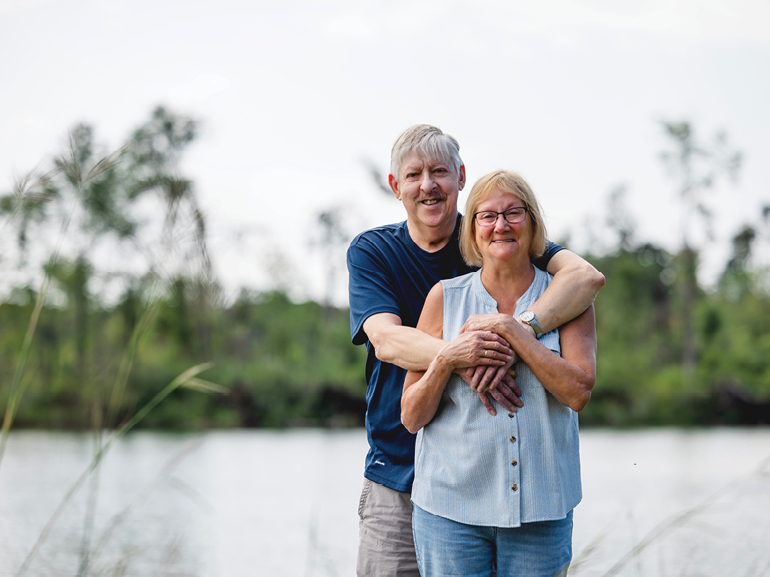
Keith Ackerman was looking forward to the first day of deer season. The night before, the 74-year-old Michigan man made his way to the large hunting blind on his property to light the furnace to counter the early morning chill.
The past year had been hard on Keith and Kris, his wife of 43 years. Keith battled cancer and underwent chemotherapy and radiation, which damaged his sense of smell and taste.
When Keith arrived at the blind before sunrise, he discovered the pilot light had gone out. He couldn’t smell the gas and lit a match. The blind exploded, severely burning his face, hands and waist.
A quarter-mile away, Kris heard the explosion – although she didn’t realize what it was.
Keith managed to crawl from the wreckage of the blind to his truck. As he tried to stand and open the door, he realized a sheet of skin was hanging from his hand. He scooped it up.
“I could hardly see at all. I listened to the gravel on the side of my truck to get to our house,” he recalls. As he got closer he could see the house and that a light was on in the darkness.
Kris was sitting on the couch. “(Keith) came in the house and said, ‘Kris, call 911 for an ambulance.’”
For the next week, Keith underwent painful treatment for his burns at Bronson Methodist Hospital’s trauma center. He then transitioned to Select Specialty Hospital – Battle Creek, a critical illness recovery hospital, for extended healing.
A physician-led, multi-disciplinary team focused on healing Keith’s wounds while also helping him to rebuild strength he’d lost as a result of his injuries.
Even before the accident, Keith was struggling to eat. The radiation treatments destroyed his saliva, making it hard to swallow food. His diet was mostly soups and nutritional drinks.
At Select Specialty Hospital, Keith underwent wound debridement twice a day. During debridement, dead skin is removed so that new skin can grow. Keith’s first debridement every day was in the shower, when a wound care nurse would soak and remove his bandages, then as gently as possible, wash his skin to prevent infection before reapplying bandages.
The wound care nurse continually spoke with a burn center to ensure Keith was getting the right care.
“I appreciated that they listened to me and let me explain how I wanted them to do things,” Keith said. For example, when he needed a break during debridement, they gave him one.
“They tried really hard to help,” he said.
Nutrition is vitally important for healing wounds and rebuilding muscle, so Keith’s daily diet included soups with nutritional powders as well as protein supplements.
Keith’s physical and occupational therapy initially included standing and walking with a platform walker – a walker with a padded platform for his forearms because he was unable to grip a regular walker and his hands hurt too much to hang by his side. As his recovery progressed, he walked the halls for endurance without the walker. Occupational therapists moved his hands and arms to help Keith regain the range of motion he had before the accident.
Even when Keith wasn’t in therapy, he was often walking the halls and pushing himself to do as much as he could on his own. “I wanted to get home,” he said.
A month later, Keith’s burns were healing well and he was back on his feet. Before he discharged home, nurses taught him and Kris how to continue to care for his wounds and eat a diet that would progress his recovery.
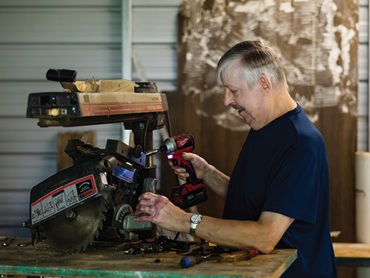
Two months after discharging home, Keith is still working toward regaining complete use of his hands and fingers. “They are healing, but it’s taking a long time,” he said.
He’s starting to eat solid food.
He’s grateful for the support of his family – especially Kris – who encouraged him amid the most challenging days. And, he’s grateful for the care team that treated him with compassion and kindness.
“They made it a lot more tolerable,” he said.